We thought we sold software. We sold a standing team
The money in coupon systems was never the module. It was the people keeping it alive — and then the category stopped existing
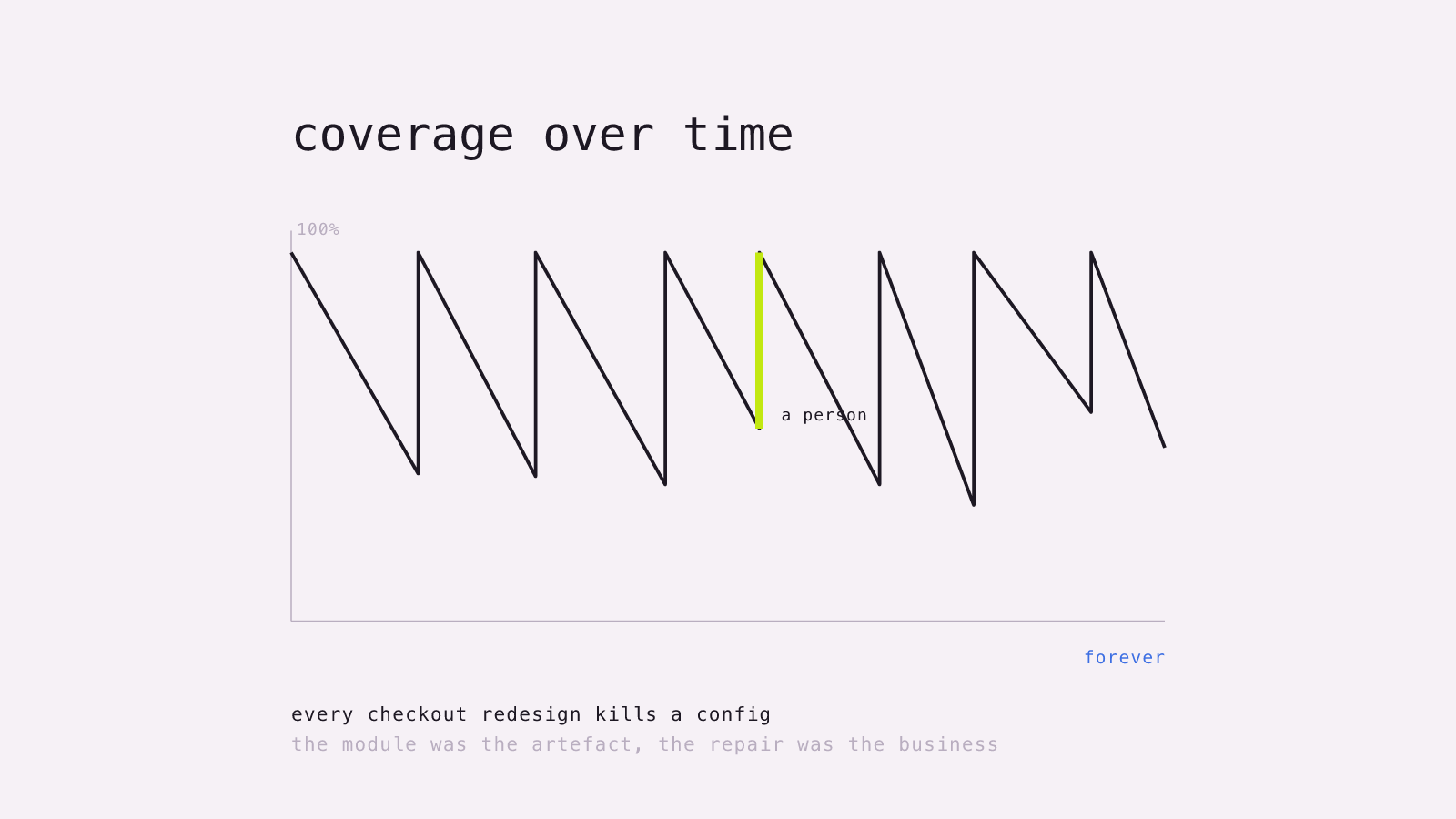
We sold Coupon Genius every way it could be sold. The integration module for extensions that already existed. A full build for the ones that did not. Consulting on the parts in between. All of that found buyers — cashback services, brands with a shipped extension and no coupon layer, companies who wanted the whole thing made for them.
None of it was where the money was.
The money was in support
A coupon system is a set of per-store configurations, and configurations rot on someone else’s release schedule. Every checkout redesign kills one. Nobody tells you it happened; the success rate for that store just quietly goes to zero.
So what a client actually needs is not a module. It is a standing team that watches the numbers and repairs configs indefinitely. That is what got budgeted, sometimes at real headcount, and that is what we staffed. Our people, hired by us, paid for by the client.
The thing worth saying plainly is what those people were. Not developers in the full sense. People who could open devtools, read a DOM tree, understand what the styles were doing, and debug a network request. Everything else — the engine, the state machine, the retrievers, the escalation pipeline, the dashboards — was already built. The job was diagnosis and a config edit.
That is a good business. It is also not the business we thought we were in, and the difference took a while to admit. We described ourselves as building coupon software. We were running a maintenance operation with excellent tooling attached.
Which is where the automation came from
If the product is a standing team, the obvious move is to automate the team.
So we did the work: a model that reads a stripped checkout page and writes the configuration, live traffic as the test suite, an escalation pipeline that routes what breaks to a human. The engineering side of that is written up separately. It worked, in the sense that it covered stores nobody would otherwise have configured.
It did not replace the team, and it was not close. Cost and quality both, in a proportion I still cannot cleanly separate — and underneath both, a mismatch we should have caught earlier between what we said the thing did and what the code actually did.
The industry-level check is the part I find most persuasive. No market leader in this category runs coupon configuration automatically. Not then, not now. It is all still hands on keyboards, at every company doing it at scale. When everyone with more money than you has looked at the same automation and kept the people, the null result is probably not about your implementation.
Then the category went away
On 21 December 2024 a YouTube investigation accused Honey — the PayPal-owned coupon extension, bought for four billion dollars — of overwriting creators’ affiliate tracking with its own at checkout, and of claiming the commission even when it found no discount to apply. PayPal disputed the allegations, saying the extension followed established industry practice on last-click attribution.
What followed mattered more than the argument. Over twenty class actions. An affiliate network stating in January 2026 that its own investigation had confirmed breaches of its publisher policies, suspending payments and access pending remediation and source-code verification. Roughly seven million Chrome users and seven thousand merchant partnerships gone. And a Chrome Web Store policy change with the sharpest edge of all: an extension may not take an affiliate commission unless it actually delivered a discount.
Read that last one as a business model rather than a rule. Coupon extensions were never funded by coupons. They were funded by attribution — by being the last click before the purchase. Requiring a real discount to earn the commission removes the revenue from every store where no working code exists, which is most stores, most of the time.
The knock-on is what finished it. Merchants pulled back from public codes. Affiliate networks tightened. The supply of coupons that are real, current and actually applicable — the thing the whole machine existed to apply — largely dried up. No coupons, no category.
Our system had already found no meaningful commercial demand well before that, so this is not our post-mortem. It is the ending of the market we were in, and it did not arrive as a competitor or a technology shift. It arrived as a twenty-three-minute video about affiliate cookies.
What I take from it
Two things, and I am not sure they generalise.
The first is that we misidentified our own product for years. The module was the artefact; the recurring cost of keeping configurations alive against the outside world was the business. Once you see it that way, the automation project reads differently — it was an attempt to escape being a services company, funded by being a services company.
The second is that a category can die from something that has nothing to do with whether the technology works. Ours worked. The engine still runs; the state machine is still how we think about checkout automation. The reason there is nowhere to point you is not that the code stopped functioning. It is that the coupons stopped existing.