Two hundred thousand tokens
Our agents stop at 200k tokens of context. We thought the line was a safety margin. A thousand sessions later it turned out to sit where the quality was already gone
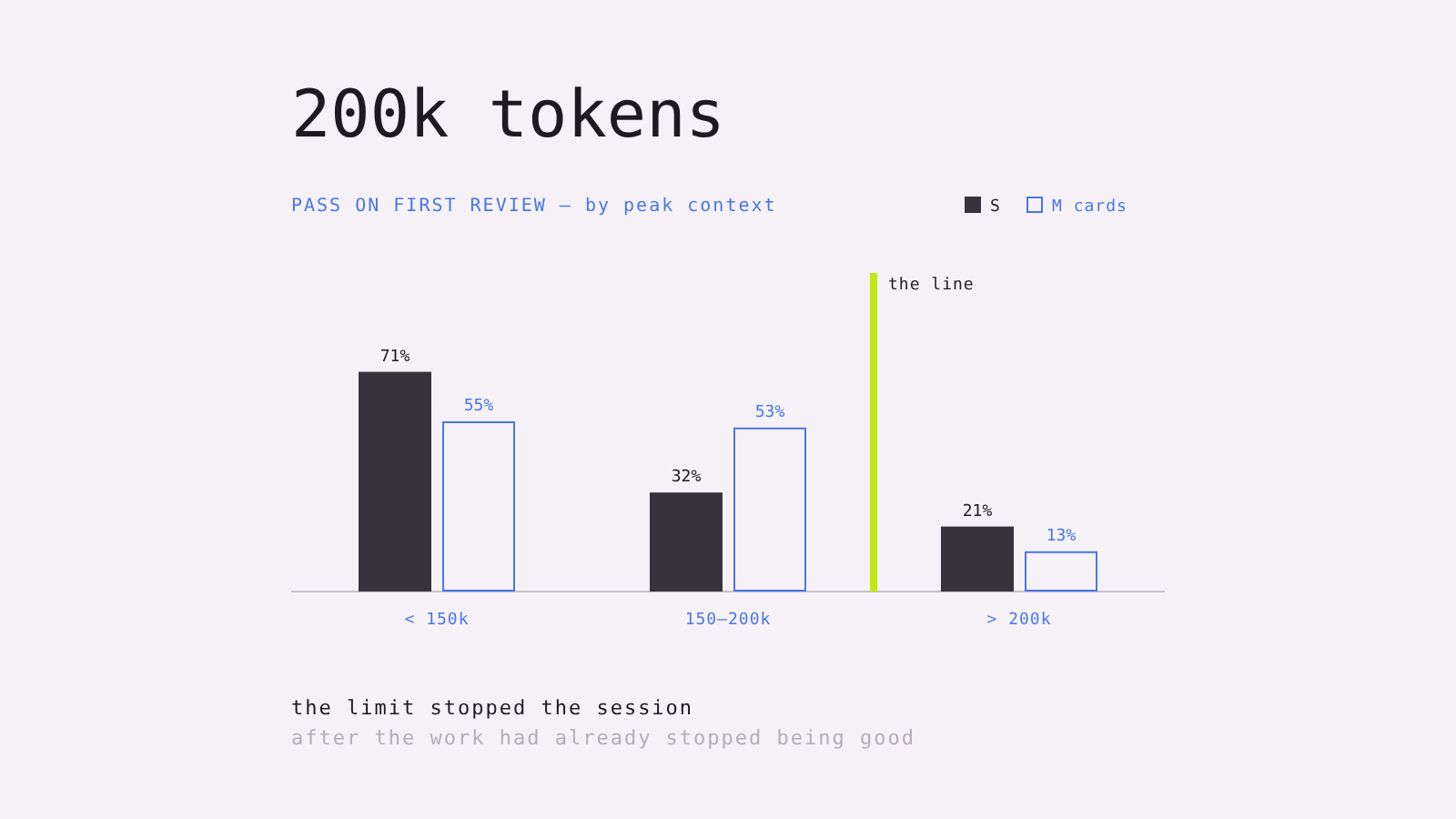
Every agent session in Mikoshi has a context line. At 200k tokens — 80% of what we took to be a 250k window — the session is told to wrap up. We drew that line as a safety margin: leave some room, stop before the model runs out.
Then we looked at what actually happens near it.
What we measured
1,026 sessions since 19 October, plus 202 interactive windows. Three kinds of session matter here:
- launch — takes a card and does the work
- answer — responds to what the reviewer found
- review — checks the result and returns pass or changes
All of it came from a copy of the event database; the live one was not touched. There were 351 launch sessions, 210 answer and 461 review.
For every launch session we took two numbers: the peak context it reached, and the verdict of the first review of its work. Then we split by card size, because a big card is harder anyway and would blur everything else.
Pass on the first review, by peak context
| Peak context | S (n=144) | M (n=121) | L (n=27) |
|---|---|---|---|
| under 150k | 71% | 55% | 100% |
| 150–200k | 32% | 53% | 100% |
| over 200k | 21% | 13% | 14% |
The L column is only 27 cards, so read it as a hint, not a result. S and M are enough.
Past 200k the first review almost always comes back with changes, whatever the size of the card. Within one size the drop is the same: medium cards go from 55% to 13%. So it is not that big cards are harder. It is the context.
The line works too well
The distribution of where sessions end has a spike in it. 74 launch sessions finished between 200k and 220k. The neighbouring 10k intervals hold about ten each.
That is not sessions finishing their work. That is sessions hitting the line and handing over what they have:
- context grows
- 200k line
- push what exists
- review: changes
The line does exactly what it was built to do. It stops the session. It just stops it after the point where the work stopped being good.
The rest of the numbers
Answer sessions fall off earlier. Under 100k they pass 53% of the time, between 100k and 150k 38%, and above 150k three out of nineteen.
Review sessions never went above 115k. Reviewing is cheap in context, and it shows.
Spend limits barely matter. Launch sessions reach a p95 of 1.47M tokens spent, and only two crossed 2.4M. Sessions run out of context, not money.
Interactive windows live right up to the line: median 188k, p90 200.5k.
And the denominator on our own board is wrong. We drew 250k as the window. Sessions reached 331k. The real ceiling is higher than the one we were dividing by — which means the line at 80% was never 80% of anything.
What we want instead
Stop the session before the cliff, not on it.
- 150k
- write handoff
- fresh session
- same card
For launch and answer, around 150k the session writes a handoff and ends, and the bus picks the card up again in a clean context. Today the same session rushes to push half-finished work, and review sends it back.
The second change is upstream. A card that needs more than 150k of context to finish was cut too big. The part of the system that slices tasks should learn that from these runs, not from us.
The caveat
This is correlation. Sessions that grow long might be the ones that were already going badly.
But the spike at 200–220k is hard to explain that way. Sessions do not pile up at an arbitrary number by themselves. They pile up where we told them to stop.
We set a limit to protect the work. For two weeks it was measuring how much of the work had already been lost.