The rule was the bug
An agent hit a rule in our design doc, stopped and asked. It did everything right. The post was fine; the rule was wrong — and only a person could say so
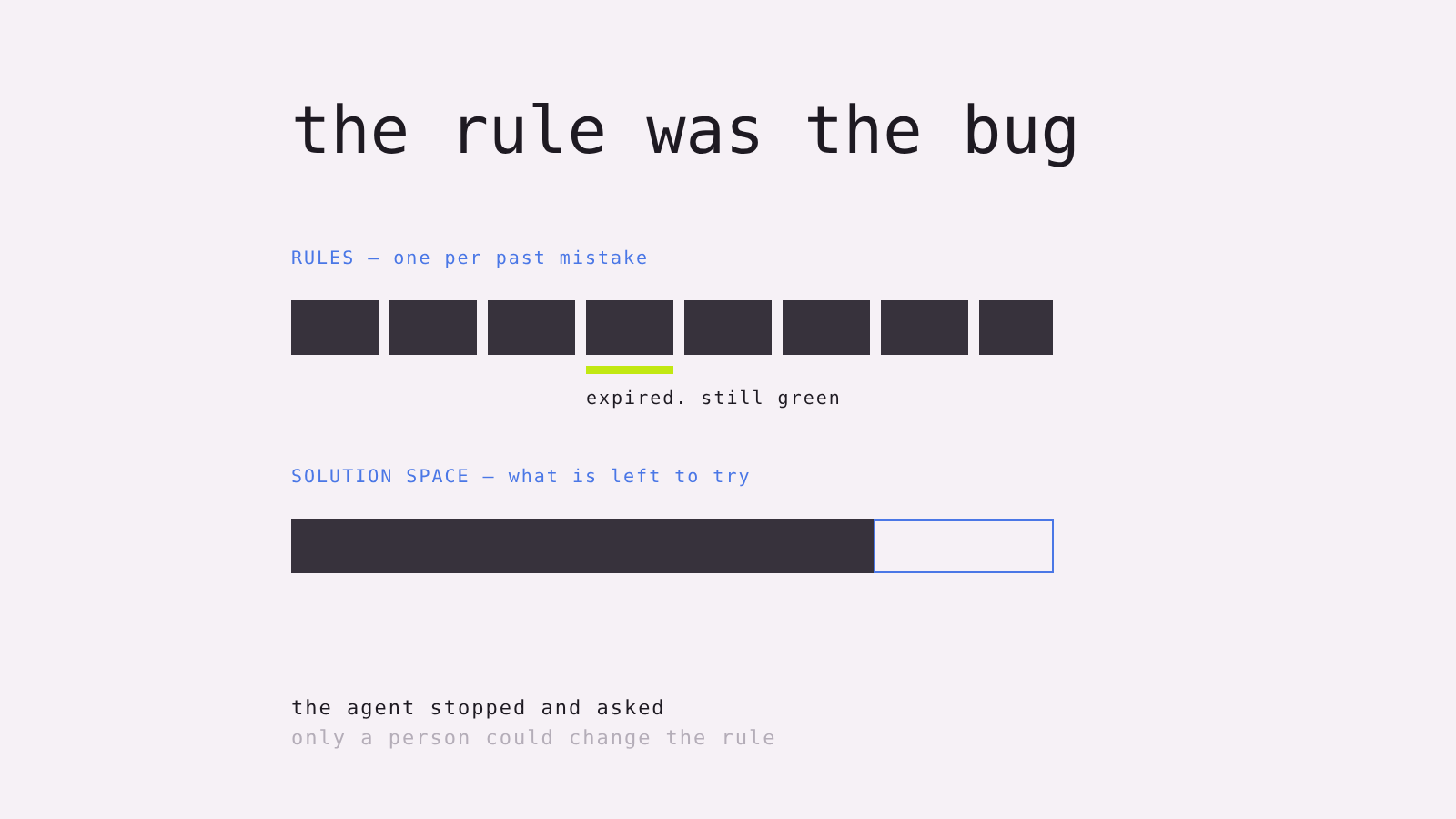
This site has a design document. Among other things it says what a journal post may contain: date, title, prose. Diagrams and code sheets belong to engineering pages.
An agent was writing one of our posts. The post needed a small diagram — a stack, three layers, the kind of thing that is faster to see than to read. The agent reached for the component, found the rule, and stopped. It did not write the diagram. It did not quietly break the rule either. It asked.
That is exactly what we want from an agent. And the answer was: the post is fine, change the rule.
Rules are written for yesterday
Every rule in a repository started as a fix. Somebody shipped something bad, somebody wrote down how not to do it again. CLAUDE.md, design docs, lint configs, agent instructions — they are scar tissue, and mostly they are right.
They are also a record of what we knew at the time. The journal rule was written when the journal was flat editorial and nothing else. Then posts started describing systems, and the rule kept describing the old journal.
A rule does not know it has expired. It keeps passing every check, because it is the check.
Fast and slow
There are two modes an agent works in, and they map well onto the usual fast and slow thinking.
Fast is pattern matching against what it was given. Read the rules, find the one that applies, follow it. Cheap, quick, and almost always correct — which is why our tooling starts every task at the lowest reasoning effort and climbs only when the evidence says it has to:
- low
- low
- medium
- high
Slow is asking whether the rule fits the situation at all. That costs more. When we measured it, our careful mode came out at about twelve times the price of the cheap one for the same kind of task, and two and a half times slower to merge.
Here is the trap. The ladder climbs on failure. A wrong rule does not fail. The post without the diagram passes every check; it is just worse. Nothing goes red, so nothing climbs.
Guard rail and ceiling
The more rules accumulate, the better the agent is protected from slop. And the smaller the space of solutions it is allowed to consider.
- rules
- less slop
- smaller solution space
You cannot have one without the other. A rule that blocks the bad answer also blocks every good answer that happens to look like it. Our agent did not miss the diagram because it was not smart enough. It missed it because it was obedient enough.
So the useful question is not how to write better rules. It is who notices when a rule is now wrong.
Who says it does not add up
Not the agent, at least not on its own. An agent that overrides rules whenever they feel inconvenient is the problem rules were written to solve. What it can do is what ours did: stop at the point of friction and make it visible. That is the signal.
The decision belongs to a person. Only the owner of a rule can say it no longer holds, because only the owner knows why it was written.
Two things we do to keep that loop cheap:
- Law and strategy are kept apart. A few rules are law: evidence must be real, a check has to be able to fail, an agent’s own report of success is not evidence. Those do not bend. Everything else is strategy — how we usually do things — and strategy is expected to change.
- The rulebook has a size limit. Decisions in force are capped at 8000 bytes. A new rule that does not fit pushes an old one into the archive. The pile cannot grow forever just because nobody had time to clean it.
Neither of these tells you which rule is wrong. They just make it cheaper to find out.
What we changed
The design document now allows diagrams in engineering posts. The post got its stack. The rule took one line to change, after a person read the question and said yes.
The interesting part is everything before that line. The agent did its job by stopping. The rule did its job by holding. The mistake sat in the space between them, where no check reaches — and that space, as far as we can tell, still needs a human in it.