Merged, with a tail
When the only thing a reviewer finds is a test that could be stronger, we merge the change and file the rest as its own card. Forty-three of them in a week, and what that bought us
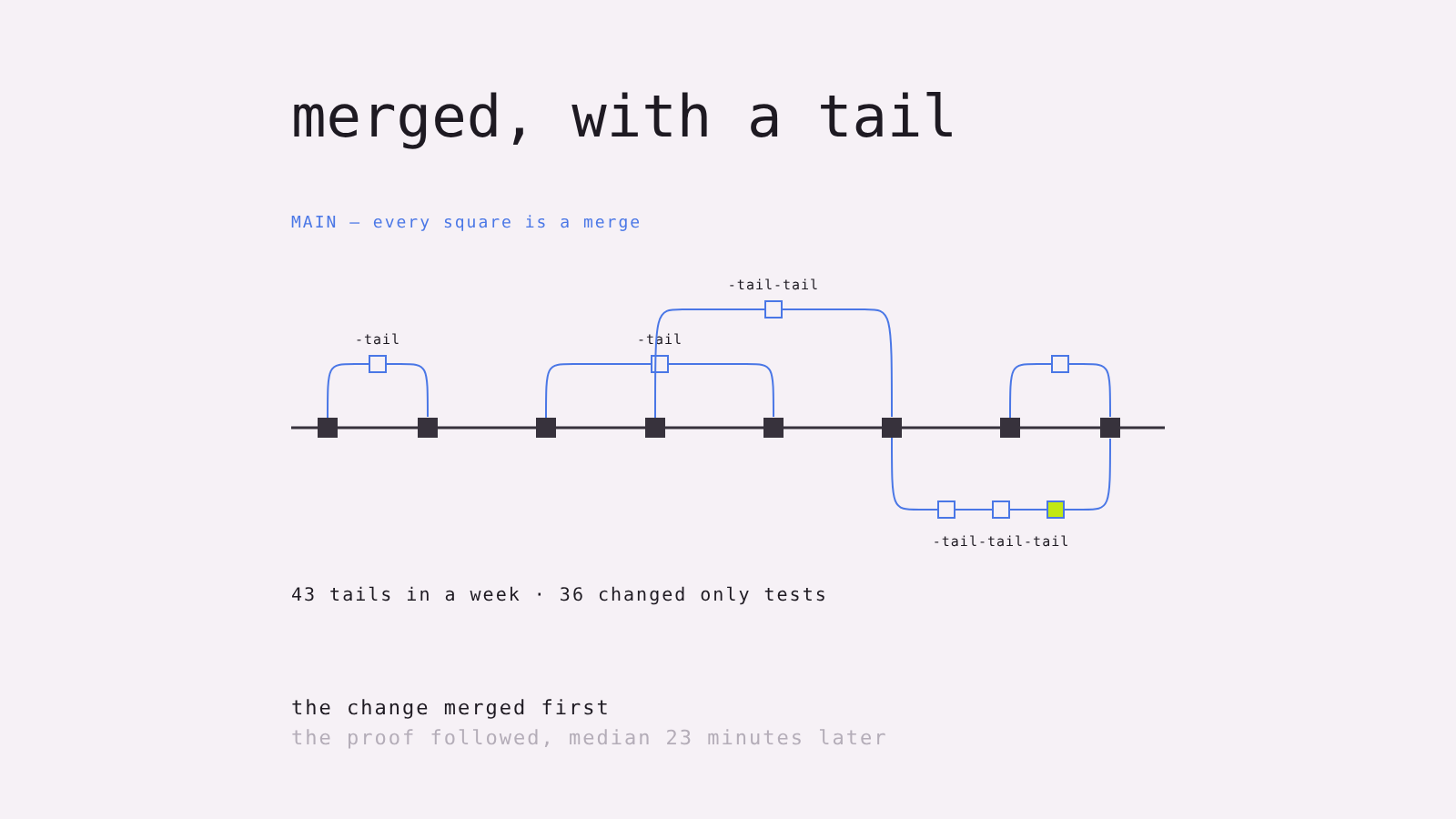
Every pull request in Mikoshi goes through review by an agent that did not write it. Part of that review is mutation testing: the reviewer changes the new code on purpose — flips a condition, drops a line, returns early — and runs the tests again. If they still pass, the mutation survived. The code may be right, but nothing pins it down.
For a while, a surviving mutation meant the card went back. Another round: a new session opens, reads the findings, strengthens the tests, pushes, waits for review again. A change that already worked sat in a queue for an hour so that a test could become stricter.
The rule
Since 17 November the review does something else when every finding it has is a surviving mutation, and nothing else.
- review
- only surviving mutations
- pass and merge
- tail card filed
The change merges. The findings go into a new card, named after the parent with -tail on the end, size S, high priority. The tail goes through the same lifecycle as anything else: its own session, its own pull request, its own review.
Two details hold it honest.
If the tail card cannot be filed, the verdict falls back to changes. The merge is paid for by the card. No card, no merge.
And a later tail replaces an earlier one. If the same work is reviewed again and leaves different findings, the older tail is dropped, so there is never more than one open debt per change.
A week of tails
| tail cards, 17–24 November | 43 |
| tails that touched only tests | 36 |
| tails of tails | 7 |
| tails of tails of tails | 1 |
| parent merge to tail merge, median | 23 minutes |
| same, 90th percentile | about 2 hours |
Thirty-six of forty-three changed nothing but tests. That is the point: the behaviour that merged was the behaviour that stayed. What arrived later was the proof that it would keep behaving that way.
The tail of a tail is the interesting row. It means the stronger tests were reviewed, mutated again, and still had a gap. Seven times the second round found one. Once the third did. Each time the change on main was already doing its job; each time the debt had a number and an owner until it was paid.
Why not just make the first round stricter
Because “stricter” is a loop, and loops cost sessions. A review that refuses until every mutation dies turns one card into three or four rounds, each paid in full, each with the change itself blocked behind it. Our reviews already have a round limit, and a card stuck on test strength was spending rounds on the least risky part of the work.
A tail splits the two things a review checks. Is the change right? Is it proven well enough? The first one gates the merge. The second one gets its own card.
The part that matters
The easy version of this is to merge and forget. Write “tests could be better” in a comment, close the pull request, never look again. Most teams have a thousand of those comments.
The difference is that a tail is not a comment. It is a card in the same queue as everything else, picked up by the same machinery, usually within half an hour. The factory is allowed to say “done, except this”, but only if the “except this” is written down where it cannot be ignored.
A change that merged with a tail is not finished. It is finished with a receipt.